If you are choosing a jewelry laser welder, the viewing system may affect your daily experience more than you expect.
Should you look through a microscope while welding, or work from a CCD camera and monitor?
The short answer is:
A CCD camera is usually easier for beginners and more comfortable for long sessions. A microscope gives experienced jewelers better visual detail and depth perception for very fine repairs.
If your work includes both general jewelry repair and precision prong or pavé work, a machine that combines microscope + CCD viewing can offer the best balance.
Here is the practical difference:
Factor | CCD Camera | Microscope |
|---|---|---|
Beginner-friendly | Excellent | Moderate |
Learning curve | Shorter | Longer |
Long-session comfort | Better | Depends on posture |
Fine-detail visibility | Good | Excellent |
Depth perception | Limited by display | Better |
Training employees | Excellent | Less convenient |
Prong / pavé repair | Good | Better |
General jewelry repair | Excellent | Excellent |
Best for | Beginners, teams, daily repair | Goldsmiths, precision work |
So there is no single winner for every jewelry shop. The easier system depends on the type of work you actually perform.

Why Is a CCD Camera Easier for Beginners?
The biggest advantage of a CCD system is simple: you work from a screen instead of keeping your eyes inside a microscope.
That makes the basic welding process easier to understand.
The operator places the jewelry in the working chamber, finds the target on the screen, aligns the welding point with the crosshair, adjusts the piece, and triggers the laser.
For someone using a laser welder for jewelry for the first time, this is usually more intuitive than learning eyepiece position, focus, hand placement, crosshair alignment, and microscope posture at the same time.
A screen also makes training easier.
If an experienced operator is teaching a new employee, both people can see the same weld area. The trainer can point to the prong, seam, crack, or previous weld and explain exactly where the next pulse should go.
With a binocular microscope, only the operator looking through the eyepieces sees exactly what is happening.
That difference becomes important for jewelry stores or repair centers that expect more than one employee to use the machine.
CCD is usually the easier choice when:
You are new to laser welding
Several employees will share the machine
You regularly train new operators
Most jobs are general ring, chain, clasp, or porosity repairs
You spend long periods at the welding bench
You prefer working from a monitor rather than eyepieces
Comfort is another advantage.
Looking forward at a properly positioned screen allows a more neutral head and neck position. That can make a noticeable difference during long repair sessions.
However, the monitor still needs to be positioned correctly. A screen that is too low, too high, or off to one side can create its own ergonomic problems.
CCD does not automatically make a jewelry welding machine comfortable—the entire workstation still needs to fit the operator.

When Is a Microscope Better for Jewelry Laser Welding?
A microscope takes slightly more time to learn, but it still has an important advantage:
direct optical detail.
This matters most when the weld becomes extremely small.
Consider jobs such as:
Retipping a very fine prong
Repairing pavé settings
Welding close to gemstones
Rebuilding thin edges
Filling tiny porosity
Joining very small components
Working with extremely narrow seams
In these applications, you need to see exactly where the edge of the metal begins and ends.
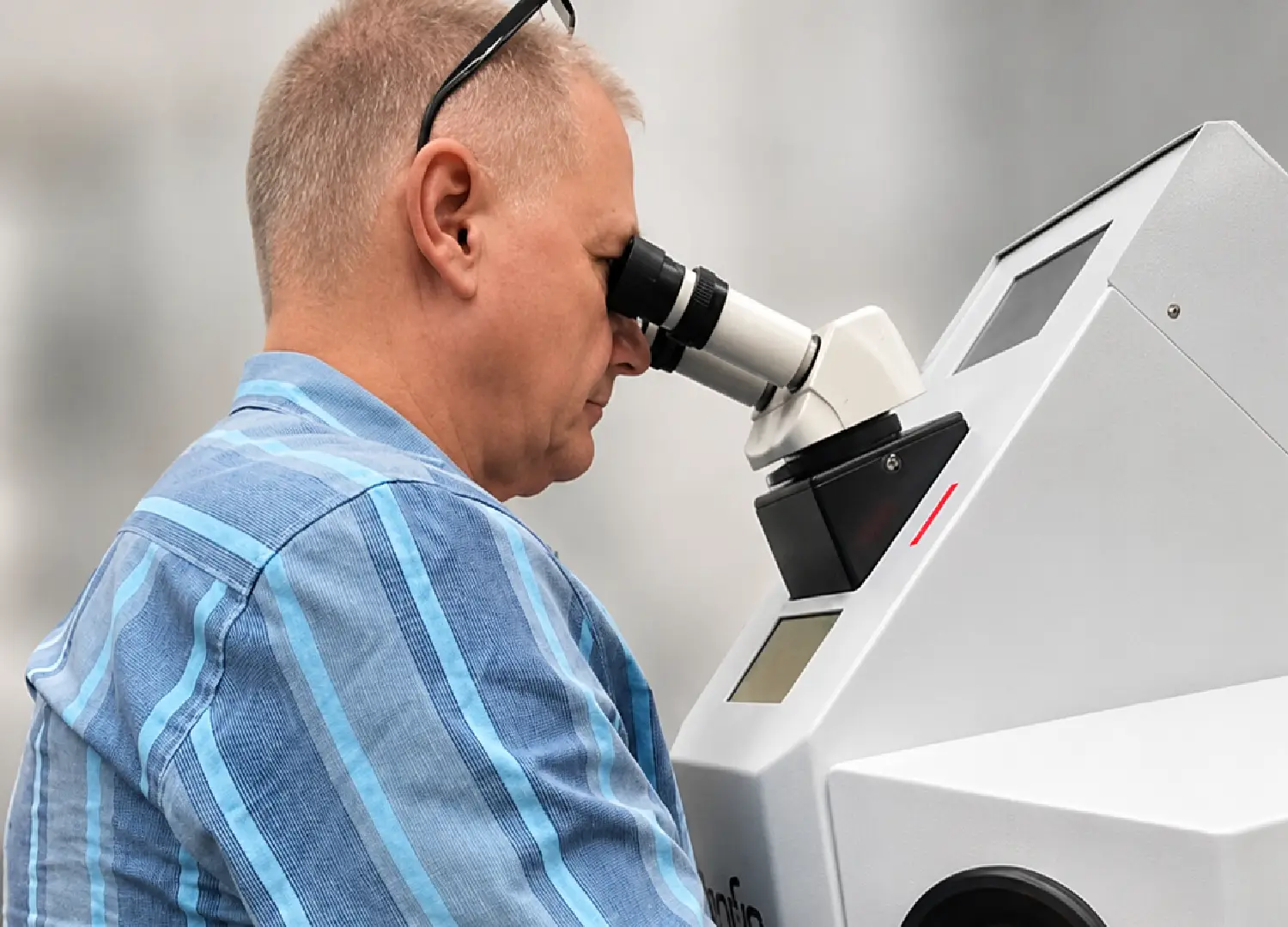
A binocular microscope provides direct optical magnification and better depth perception. That can make hand positioning and judging the distance between small components feel more natural to an experienced bench jeweler.
Digital screens can provide impressive magnification numbers, but increasing the size of an image is not always the same as increasing real optical detail.
For ordinary repairs, that difference may not matter.
For very fine prong or pavé work, it can.
This is why many experienced goldsmiths are comfortable using a microscope-based jewelry laser welding machine even if a CCD system appears easier at first.
The microscope becomes less of a learning obstacle once the operator develops muscle memory.
Microscope viewing is usually the better choice when:
Fine jewelry repair is your main business
You frequently work on small prongs or pavé settings
You already use microscopes for stone setting or bench work
Accurate depth perception matters more than screen convenience
One experienced goldsmith will operate the machine most of the time
The trade-off is ergonomics.
If the microscope height and angle do not match the operator, long periods of looking downward can cause neck and shoulder fatigue.
That is why microscope quality should not be judged by magnification alone. Eyepiece angle, working height, arm support, and operator position matter too.
Which Setup Is Better for Different Jewelry Repair Jobs?
The easiest way to choose is not by asking which visual system is technically “better.”
Ask instead:
What jobs will I perform most often?
For everyday repair work such as ring resizing, broken chains, clasps, porosity filling, and general spot welding, both systems can work well.
CCD usually has the usability advantage because these jobs do not always require maximum optical detail.
For precision repairs around very small components, the balance shifts.
Jewelry Work | Better Choice |
|---|---|
Ring resizing | CCD or microscope |
Broken chain repair | CCD |
Clasp repair | CCD |
General porosity repair | CCD or microscope |
Basic prong repair | Either |
Very fine prong retipping | Microscope |
Pavé repair | Microscope |
Stone-set jewelry | Microscope or dual system |
Training new operators | CCD |
Multiple employees sharing one machine | CCD |
High-precision goldsmith work | Microscope |
Mixed repair shop | Dual system |
This is also why you should avoid choosing a laser jewelry welder based only on laser power.
For jewelry repair, being able to clearly see and position the weld is just as important as having enough pulse energy.
A powerful machine with an uncomfortable or unsuitable viewing system can slow down daily work more than a lower-powered machine that fits your operator and repair mix properly.
Is a Microscope + CCD Dual System the Better Choice?
For many professional repair shops, this is the most practical answer.
A dual visual system allows the operator to use the microscope when maximum precision is required while also displaying the work area on a monitor.
That gives you several advantages.
For the operator:
The microscope remains available for fine positioning.
For training:
Another employee can follow the repair on the screen.
For demonstrations:
Customers or trainees can see what the operator is doing without looking through the microscope.
For different jobs:
You are not forced to choose one viewing method for every repair.
This makes a dual system particularly useful for shops handling a mixture of ring repairs, chain repairs, prong rebuilding, stone-set pieces, and precision custom work.
However, having both systems does not automatically make a jewelry welder better.
The quality of each viewing system still matters.
A poor camera with noticeable delay or low image clarity is not improved simply because a microscope is installed next to it. Likewise, an uncomfortable microscope with limited adjustment can still become tiring during long shifts.
The goal should be usable vision, not the longest feature list.

What Should You Check Before Choosing?
Instead of comparing only magnification numbers, test how the viewing system fits your actual workflow.
Pay attention to five things.
1. Image clarity
Can you clearly distinguish small edges, seams, cracks, and prongs?
Do not judge this only from the advertised screen resolution or magnification ratio.
2. Crosshair alignment
The position shown through the visual system should correspond accurately with the actual laser welding point.
For precision repair, consistent alignment is more important than having a very large image.
3. Working posture
Sit at the machine as if you were going to use it for several hours.
Check whether your neck, shoulders, arms, and wrists can remain in a natural position.
For microscope systems, check the eyepiece height and angle.
For CCD systems, check whether the screen can sit near normal eye level.
4. Working chamber visibility
You still need enough room to hold rings, bracelets, chains, and larger jewelry pieces comfortably while keeping the target visible.
A good camera or microscope cannot compensate for an awkward working chamber.
5. Who will use the machine?
A single experienced goldsmith and a retail jewelry store training three employees have very different needs.
If the machine will be shared, CCD or dual viewing becomes more attractive.
If the machine will mainly be used by one experienced precision jeweler, microscope quality may deserve more attention.
So, Is a Microscope or CCD Camera Easier to Use?
If ease of use is your main priority, choose CCD.
It is generally easier for beginners to understand, more convenient for training, and more comfortable for operators who prefer working from a screen.
If maximum precision on extremely fine jewelry is your priority, a microscope still has an advantage.
It provides direct optical detail and depth perception that experienced goldsmiths often prefer for delicate prong, pavé, and stone-set repairs.
And if your shop handles both types of work, a microscope + CCD dual visual system gives you the most flexibility.
A simple way to decide is:
Beginner or multi-operator shop → CCD
Experienced precision goldsmith → Microscope
General repair + fine jewelry work → Microscope + CCD
The best viewing system is not the one with the highest advertised magnification. It is the one that lets your operator see the weld clearly, position the jewelry comfortably, and repeat accurate repairs throughout the working day.
Not Sure Which Jewelry Laser Welder Fits Your Bench?
The viewing system is only one part of the decision. Your repair type, daily workload, working space, laser power, spot-size range, and operator experience also matter.
Explore jewelry laser welder options for repair shops, goldsmiths, and jewelry workshops, or compare different configurations based on the work you perform most often.