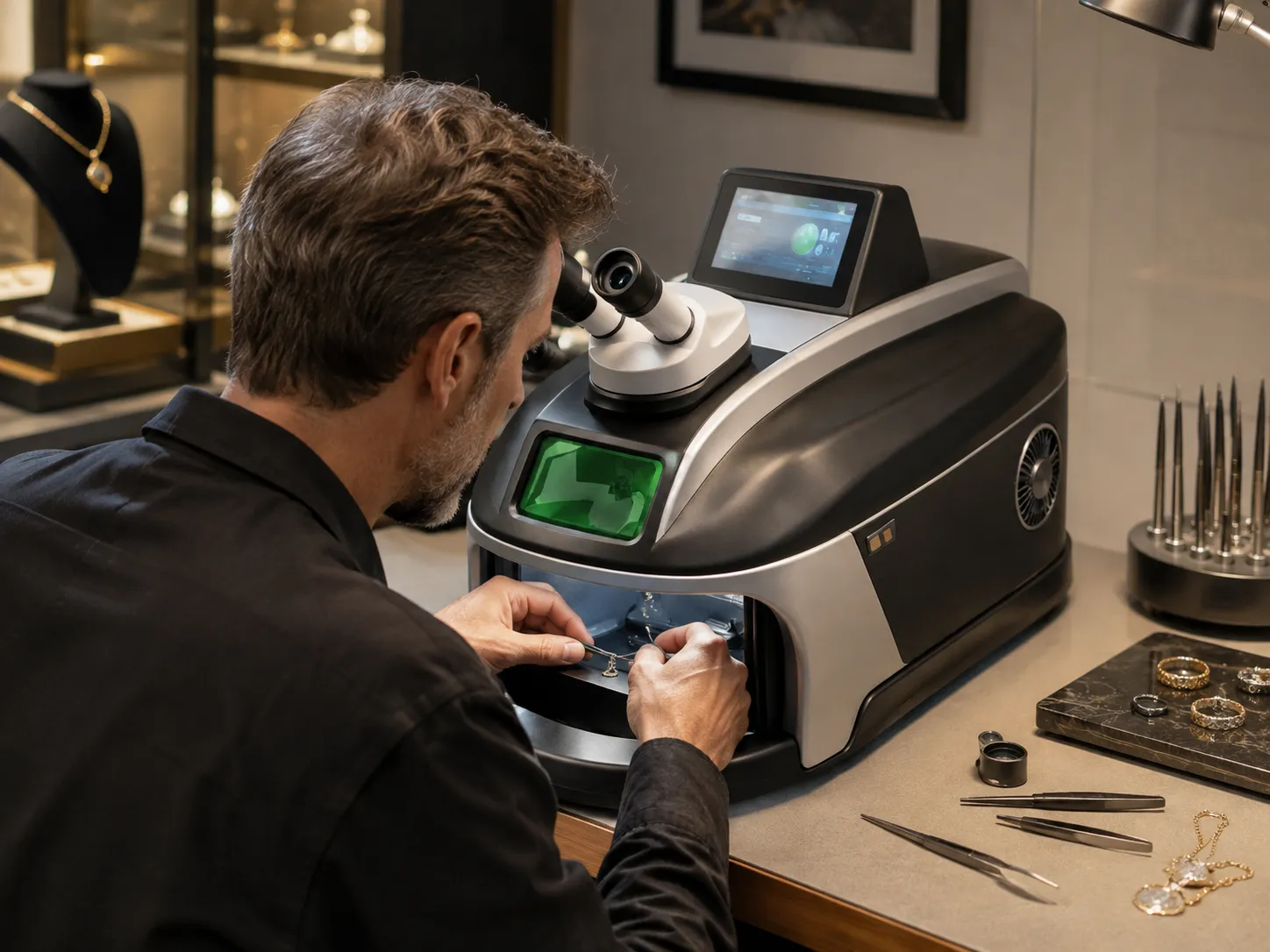
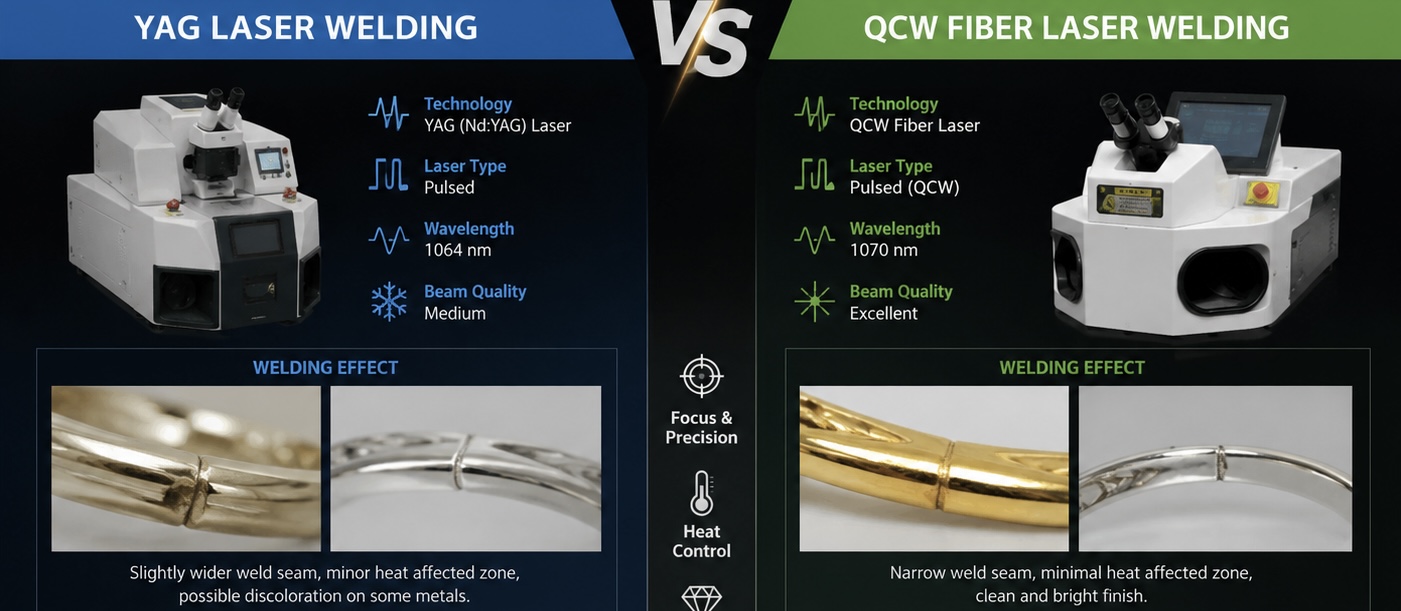
Air-cooled and water-cooled jewelry laser welders can both produce high-quality jewelry repairs. The better choice depends less on which cooling system sounds more “professional” and more on the laser technology, heat load, working time, workshop space and maintenance you are willing to handle.
For many repair shops, an air-cooled jewelry laser welder is attractive because it is compact, simpler to install and requires less cooling-system maintenance.
Water cooling becomes more valuable when the laser architecture generates more heat, the machine is operated intensively for long periods, or stable temperature control under sustained load is a major requirement.
The most important point is:
Air-cooled does not automatically mean low-power or light-duty.
Water-cooled does not automatically mean more precise or better for jewelry.
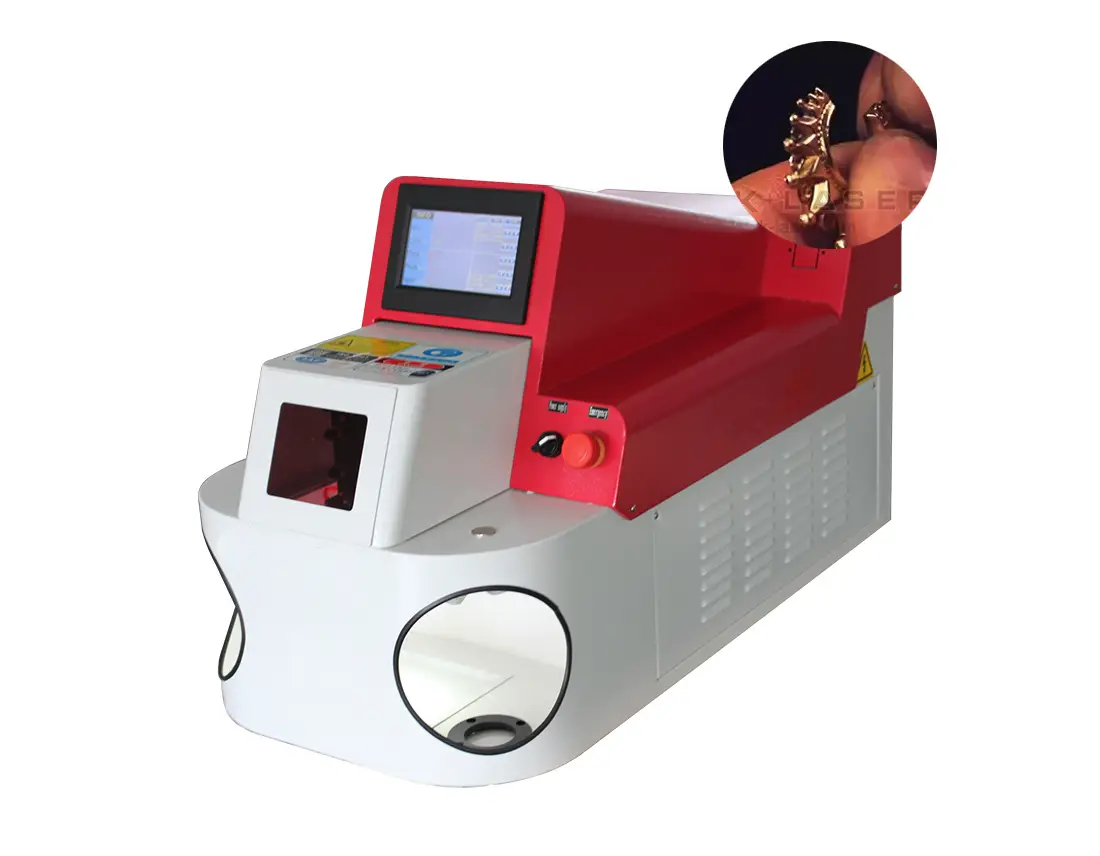
For example, JewelryLaserNova's current MW-QW QCW series is available in 60W, 120W and 200W versions with air cooling, showing why cooling method should not be judged from wattage alone.
Quick Comparison
Factor | Air-Cooled | Water-Cooled |
|---|---|---|
Cooling method | Fans / heat sinks / internal airflow | Liquid loop + pump / chiller |
Installation | Simpler | More components |
Machine size | Often more compact | Often larger |
Cooling maintenance | Lower | Higher |
Coolant required | No | Usually yes |
Best fit | Compact repair shops, modern air-cooled QCW systems | Higher thermal-load machines, intensive sustained operation |
Thermal control | Depends heavily on machine design | Strong heat-removal capacity |
Is it automatically better? | No | No |
1. What Does Cooling Change in Jewelry Laser Welding?
The cooling system has one main job:
Remove the heat generated inside the laser system so the machine can continue operating within its designed temperature range.
It does not directly create the weld.
Weld quality is still determined mainly by factors such as:
Pulse energy.
Peak power.
Pulse width.
Spot size.
Optics.
Focus.
Material.
Operator technique.
Cooling supports those systems by helping keep operating temperature under control.
How Air Cooling Works
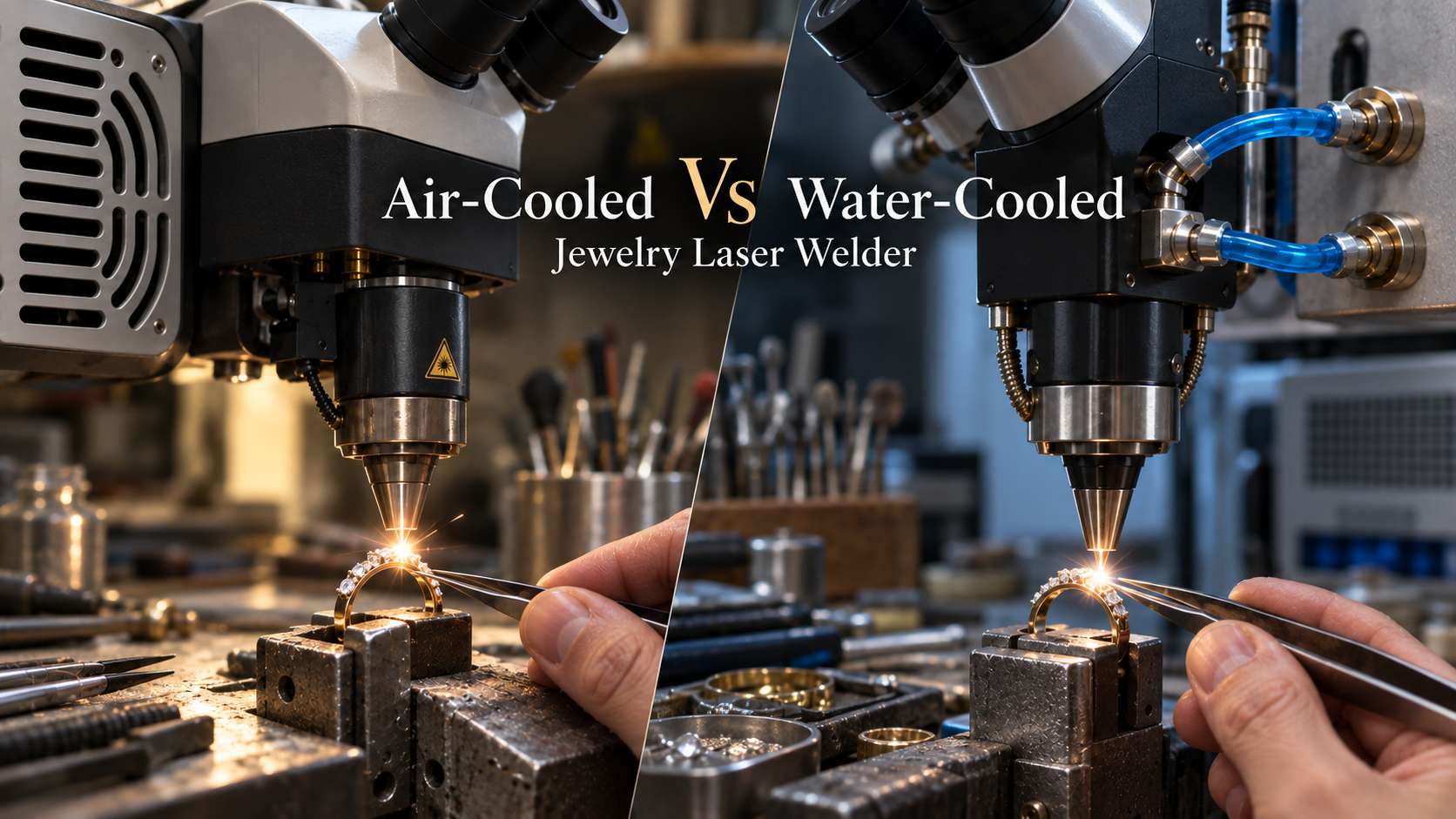
An air-cooled machine uses airflow, heat sinks and internal fans to transfer heat away from the laser source and electronics.
The main advantages are simplicity.
There is no external water circuit to manage, which usually means:
Less installation work.
No coolant replacement.
No water-quality concerns.
Fewer pumps and hoses.
A smaller machine footprint.
Easier positioning on or around a jewelry bench.
This is one reason modern QCW laser welders for jewelry can be particularly attractive to retail repair shops and goldsmiths that want professional welding capability without a large standalone cooling system.
How Water Cooling Works
A water-cooled system circulates liquid through a cooling loop and transfers heat through a heat exchanger or chiller.
Because liquid can carry heat away efficiently, this architecture is useful when the machine itself creates a significant and sustained thermal load.
Water cooling is common on many traditional lamp-pumped Nd:YAG jewelry welders because the lamp, laser cavity and related components generate substantial heat during operation.
But this is the important distinction:
Cooling method is partly a result of the laser architecture.
It is not simply:
100W = air cooled
200W = water cooled
That assumption appears repeatedly in the original draft, but it does not hold across modern jewelry welding systems.
Does Water Cooling Produce Better Welds?
Not automatically.
A water-cooled machine with poor pulse control or optics does not become more precise simply because it has a chiller.
Likewise, a well-designed air-cooled QCW system can maintain stable output while delivering fine jewelry welds.
If you are comparing two jewelry laser welding machines, evaluate the complete welding system rather than treating cooling type as a quality grade.
That includes:
Pulse stability.
Minimum spot size.
Available pulse energy.
Viewing system.
Positioning.
Shielding gas.
Foot-pedal control.
Laser source.
Cooling design.
2. When Is Air Cooling Better for Your Workshop?
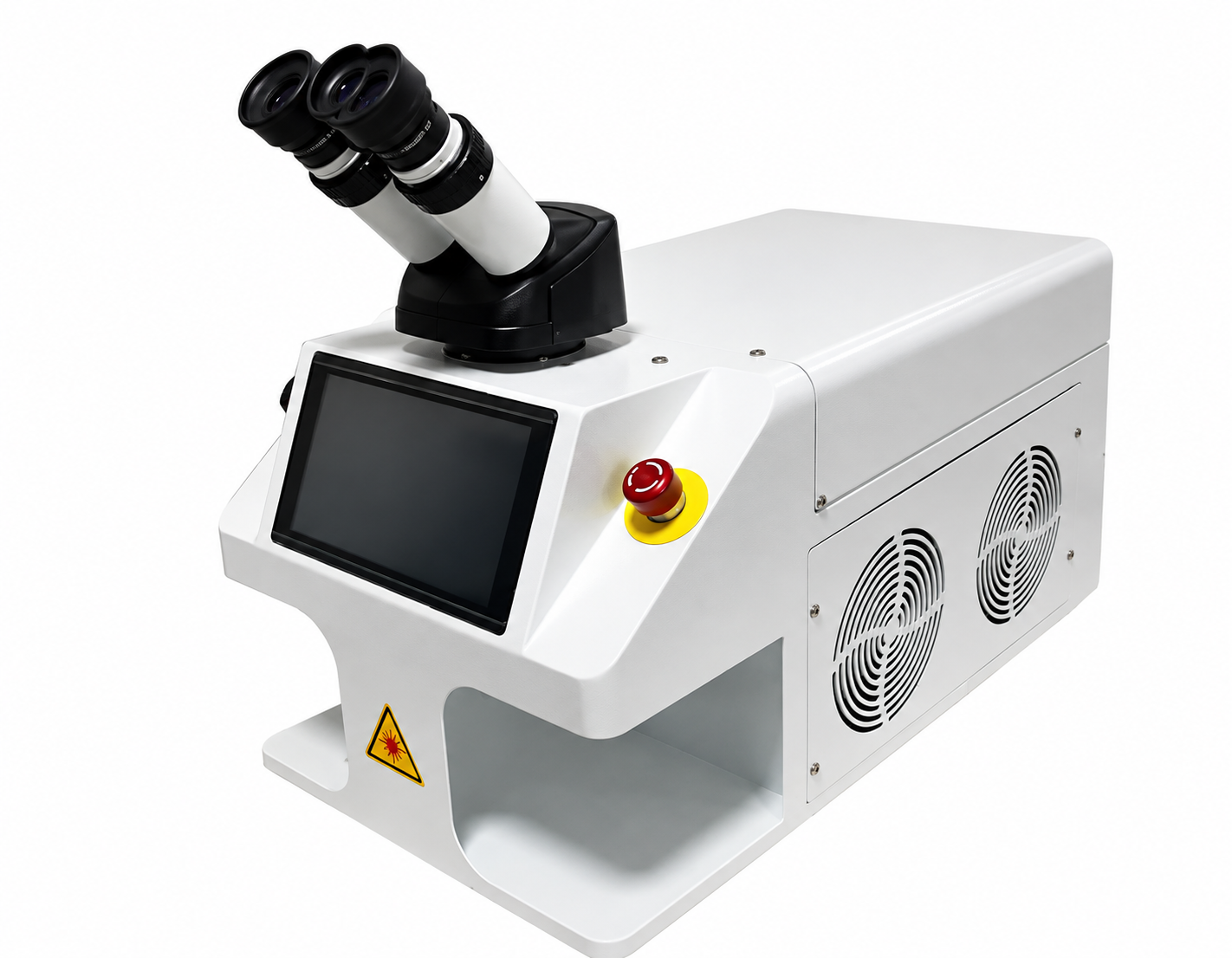
Air cooling is especially attractive when simplicity, compact size and low maintenance matter.
Small Jewelry Repair Shops
A repair counter or small goldsmith workshop usually has limited floor and bench space.
The machine may sit alongside:
Microscope tools.
Polishing equipment.
Ultrasonic cleaners.
Hand tools.
Repair inventory.
Adding a separate chiller, water tank and cooling circuit can make the installation more complicated than necessary if the laser source does not require it.
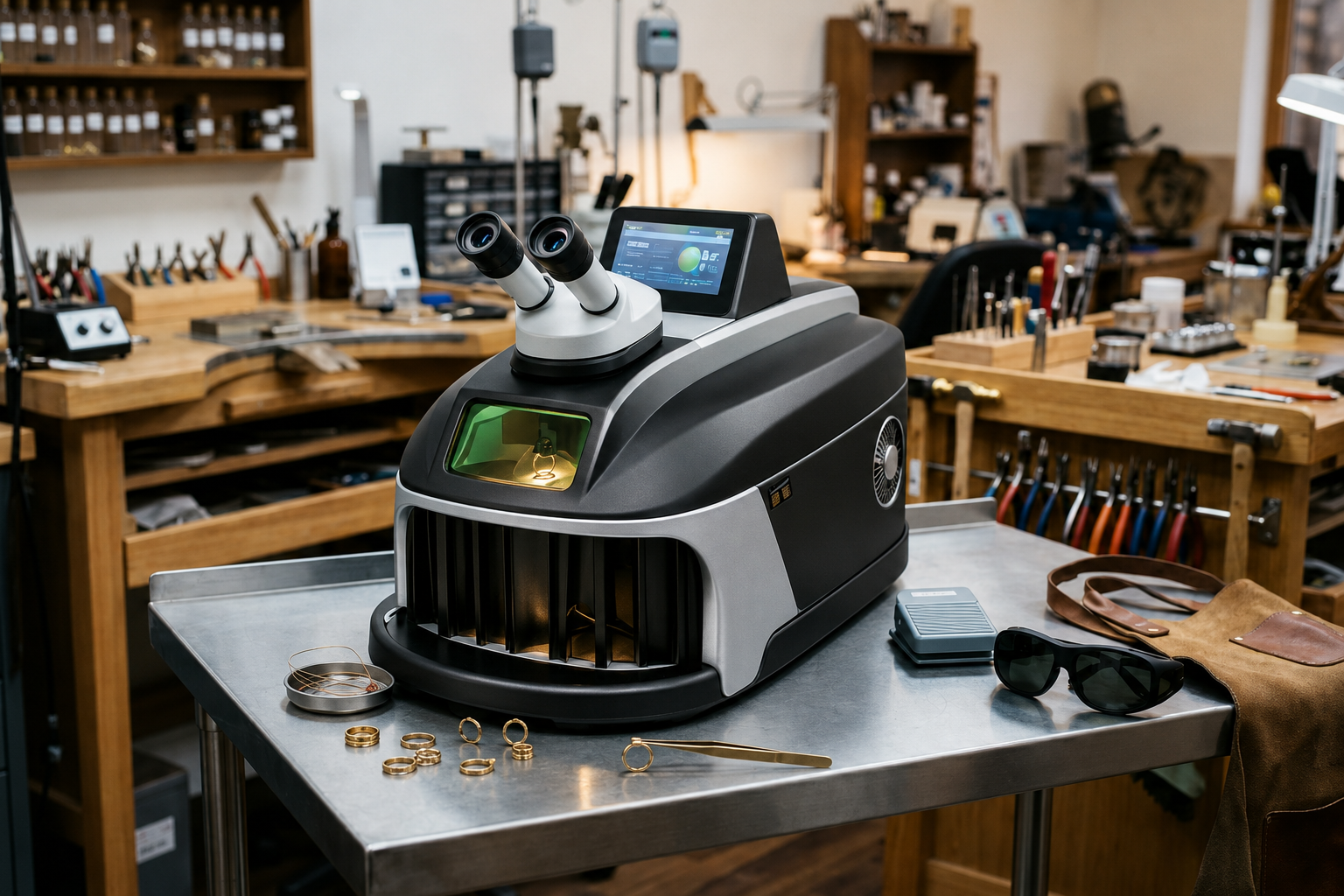
A compact air-cooled laser welder for jewelry repair can therefore be easier to integrate into an existing workshop.
Retail Jewelry Stores
For in-store repair, customers may actually see the equipment.
A compact machine with fewer external components can be easier to position behind the repair counter.
You also reduce concerns about:
Water connections.
Coolant maintenance.
Pump servicing.
Leaks.
Additional floor space.
That matters when the machine is part of a retail environment rather than a dedicated industrial room.
Shops That Want Lower Maintenance
Air cooling removes an entire maintenance system.
You still need to maintain the machine itself, including optics, filters, airflow paths and internal cleanliness.
But there is no cooling-water loop to inspect.
That means no routine concern about:
Coolant condition.
Water quality.
Pump condition.
Tank cleaning.
Hose leaks.
Scale or contamination inside the cooling circuit.
For owners who want a jewelry welder that is easier to maintain, that can be a meaningful advantage.
Air Cooling Is Not Only for Low Power
This deserves emphasis because it directly affects purchasing decisions.
JewelryLaserNova currently offers the MW-QW QCW series in 60W, 120W and 200W configurations using air cooling. The same platform is aimed at repair shops, goldsmiths, bench jewelers and jewelry stores.
So if one supplier tells you:
“You need water cooling because 200W is too powerful for air cooling.”
that statement should not be accepted without context.
Ask:
What laser technology is being cooled?
How much heat does the source actually generate?
What continuous operating conditions is the machine designed for?
Those questions matter more than nominal watts alone.
3. When Is Water Cooling the Better Choice?
Water cooling still has important advantages.
It becomes more attractive when the machine architecture creates substantial heat or your production cycle places a sustained thermal load on the system.
Traditional Nd:YAG Systems
Many traditional flashlamp-pumped YAG jewelry welders use water cooling because the laser cavity generates significant waste heat.
In that type of machine, the chiller is not an optional luxury.
It is part of the machine's thermal design.
This is why comparing an air-cooled QCW machine directly with a water-cooled YAG machine only by cooling method can be misleading.
You are also comparing:
Different laser-source architectures.
Different energy efficiency.
Different maintenance requirements.
Different pulse characteristics.
Potentially different power consumption.
Cooling is only one part of the comparison.
Long, Intensive Production Work
Water cooling can also make sense when the machine is expected to operate under heavy sustained use.
The advantage is not that weld #1 becomes magically better.
The advantage is that an appropriately designed cooling system can help manage accumulated heat during repeated operation.
If your shop performs high-frequency batch welding or operates the machine for extended periods, ask the supplier for actual sustained-operation information.
Do not rely on generic claims such as:
“Air cooling is only suitable for 2 hours.”
or
“Water cooling can always run for 8 hours.”
The original article used fixed runtime and duty-cycle figures like these, but they were drawn partly from adjacent welding equipment rather than the exact jewelry laser system being evaluated.
The correct continuous-runtime limit should come from the actual machine manufacturer.
Hot Workshop Conditions
Ambient temperature also matters.
An air-cooled system ultimately dumps heat into the surrounding air.
If the room is already hot and poorly ventilated, its ability to reject heat can be reduced.
A properly designed water-cooled system may provide more controlled thermal management in demanding conditions.
But again, do not assume this from the words “water cooled.”
Ask for the permitted operating-temperature range of the exact machine.
When Downtime Has a High Cost
A production workshop processing repeated jewelry batches may value thermal headroom more highly than a boutique repair counter.
If cooling-related interruptions would delay customer orders or stop several operators, a more robust cooling architecture can be financially worthwhile.
That is the real business case for water cooling:
not “water is more advanced,” but “the machine's workload justifies more cooling capacity.”
4. How Should You Choose for Your Workshop?
Start with your workflow—not with the supplier's cooling label.
Choose Air Cooling First If You Value:
Compact equipment.
Simple installation.
Low cooling-system maintenance.
Limited workshop space.
Retail-counter installation.
Modern QCW architecture.
Fine and general jewelry repair.
Lower system complexity.
Evaluate Water Cooling If You Need:
A laser architecture designed around liquid cooling.
High sustained thermal load.
Long, intensive production cycles.
High-energy repeated operation.
Strong cooling capacity in demanding working conditions.
A production-oriented workshop where thermal downtime matters.
The most useful decision table is therefore:
Your Workshop | Better Direction |
|---|---|
Small repair counter | Air-cooled system worth evaluating first |
Goldsmith workshop | Depends on laser technology and workload |
Retail jewelry store | Air cooling often simplifies installation |
Mixed daily jewelry repair | Either can work; compare the complete machine |
Traditional high-energy YAG machine | Water cooling may be part of the required design |
QCW jewelry welding | Air cooling can handle serious professional configurations |
Heavy sustained batch production | Compare thermal capacity and continuous-operation data |
Limited maintenance staff | Air cooling has a simplicity advantage |
Ask These Questions Before Buying
Do not ask only:
“Is it air cooled or water cooled?”
Ask:
1. What laser source does the machine use?
QCW fiber and lamp-pumped YAG can have very different cooling requirements.
2. What continuous operation is the machine designed for?
Ask for manufacturer data rather than generic duty-cycle claims.
3. What happens when the machine gets too hot?
Does output reduce? Does the machine alarm? Does it shut down?
4. What ambient temperature range is allowed?
This matters if your workshop gets hot in summer.
5. What maintenance does the cooling system require?
For water-cooled systems, ask about coolant, filters, pumps and maintenance intervals.
6. What is the machine footprint and total installation requirement?
A compact machine can matter enormously in a jewelry shop.
7. Can I see a sustained welding test?
Do not only watch one perfect weld.
Ask the supplier to demonstrate repeated welding over a realistic working session and show that parameters remain stable.
Compare the Whole Machine
If you are deciding between two machines, use a table like this:
Specification | Machine A | Machine B |
|---|---|---|
Laser technology | ||
Cooling system | ||
Average power | ||
Peak power | ||
Pulse energy | ||
Pulse width | ||
Spot-size range | ||
Continuous operation | ||
Operating temperature | ||
Machine size | ||
Cooling maintenance | ||
Training/support |
That tells you much more than simply seeing:
Air Cooled vs Water Cooled
on the quotation.
Conclusion
So, which is better: an air-cooled or water-cooled jewelry laser welder?
Neither cooling method is universally better.
Air cooling is attractive for workshops that value a compact footprint, simpler installation and lower cooling-system maintenance. Modern QCW systems also show that air cooling is not limited to entry-level or low-power jewelry welders.
Water cooling makes more sense when the laser architecture itself requires stronger heat removal or when sustained thermal load makes additional cooling capacity valuable.
The key buying rule is:
Choose the laser technology and workload first. Then evaluate whether its cooling system is appropriate.
Do not choose water cooling simply because it sounds more industrial.
Do not choose air cooling simply because the machine is smaller.
And do not let a supplier use wattage alone to justify one cooling method.
If you are comparing a laser welder for gold and silver, ask for the cooling method, laser-source type, continuous-operation limits, ambient-temperature range and maintenance requirements together.
JewelryLaserNova currently offers compact air-cooled QCW jewelry laser welders from 60W to 200W, alongside other jewelry-focused machine architectures. Send your typical repair workload, materials and expected daily operating pattern, and the team can recommend a machine configuration based on how you actually work rather than cooling labels alone.